Marrakech Morocco: Medina, Riads and Practical Travel Guide
Marrakech can be one of the easiest Moroccan cities to over-plan.
The city has palaces, gardens, museums, souks, restaurants, hammams, cooking classes, rooftop terraces, and dozens of possible excursions. Trying to fit all of them into two days often produces more time checking schedules than actually enjoying Marrakech.
The better approach is to decide what role the city has in your Morocco itinerary.
Are you:
- spending two nights before continuing to the Sahara?
- staying three or four nights and exploring Marrakech properly?
- using Marrakech as a base for the High Atlas?
- adding Essaouira?
- finishing a longer Morocco journey here?
- looking primarily for food, history, shopping, or relaxation?
For many first-time visitors, three nights can provide a good balance, but it is not a universal requirement.
Two nights may be enough in a faster cross-country itinerary.
Four or more can make sense when Marrakech itself is one of the main destinations.
The right number depends on what comes before and after it.
Start with our Morocco Itinerary Guide if you are still deciding how Marrakech fits into the complete journey.
Why Visit Marrakech?
Marrakech offers several experiences within one city:
- UNESCO-listed historic medina
- Almoravid, Almohad and later dynastic heritage
- palaces and madrasas
- souks and craft areas
- Jemaa el-Fna
- Moroccan food
- riad accommodation
- hammams
- gardens
- contemporary restaurants and museums
- easy access toward the High Atlas
- practical starting or finishing point for southern Morocco
Its appeal comes from this combination.
Marrakech’s appeal does not depend on exaggerated ideas about “sensory overload,” “hidden Marrakech” or “exclusive access.”
Marrakech is a UNESCO World Heritage City
The Medina of Marrakesh has been inscribed on UNESCO’s World Heritage List since 1985.
UNESCO traces Marrakech’s foundation to the Almoravid period in the 11th century and recognizes its long political, economic, and cultural importance.
The World Heritage property includes or relates to major elements such as:
- Koutoubia Mosque
- Kasbah
- ramparts
- historic gates
- gardens
- Badi Palace
- Ben Youssef Madrasa
- Saadian Tombs
- Jemaa el-Fna
Marrakech’s cultural importance is much stronger than any simple label such as “Morocco’s most exciting city.”
How Many Nights Do You Need in Marrakech?
There is no correct number for everybody.
One Night
Usually too short if Marrakech itself matters to you.
But it can happen in a very focused itinerary.
A traveler might:
- arrive in the afternoon
- spend the evening around Jemaa el-Fna
- complete limited sightseeing the following morning
- continue elsewhere
That is an introduction, not a complete visit.
Two Nights
Two nights can work in a faster Morocco circuit.
A practical structure is:
Day 1: arrival and light Medina exploration.
Day 2: substantial sightseeing day.
Day 3: depart.
This works particularly well when Marrakech follows several other major Moroccan cities.
Three Nights
Three nights are a strong choice for many first-time visitors.
They provide room for:
- one major guided sightseeing day
- one additional garden, food, shopping, or independent day
- evenings without immediately packing again
Four Nights
Four nights make sense when you want to include:
- cooking class
- hammam
- gardens
- substantial shopping
- free time
- an additional city day
or when Marrakech is your main base.
Five Nights or More
A longer Marrakech stay can work when you deliberately want a slow city break or are using the city as a base.
But do not spend five nights merely because someone suggests that faster Morocco itineraries are inherently inferior.
Your available time and priorities matter.
Marrakech Should Not Automatically Become Your Base for Everything
It is tempting to stay in one Marrakech hotel and make repeated excursions.
That works for some places.
It works poorly for others.
Reasonable Marrakech-based excursions may include:
- parts of the High Atlas
- Agafay
- selected nearby countryside
Essaouira can also be done as a day trip, although an overnight may be preferable when the coast matters.
Merzouga is completely different.
The Erg Chebbi Sahara should be treated as a multi-day journey, not a quick Marrakech excursion.
Read our Morocco Desert Guide before deciding which desert experience you actually want.
First Day in Marrakech
Do not automatically schedule a six-hour guided tour immediately after your flight.
Arrival time on the ticket is not the same as the time you will reach the hotel.
You may still need:
- immigration
- baggage collection
- airport procedures
- transport
- check-in
- final walk to a Medina riad
If you arrive after a long international journey, the better first day may simply be:
airport → hotel → rest → light evening walk → dinner.
Start the full sightseeing program the following morning.
Marrakech Menara Airport
Marrakech Menara Airport is conveniently positioned for travelers beginning or finishing southern Morocco itineraries.
Morocco’s airport authority currently lists:
- an official taxi station
- displayed taxi fares
- city-airport bus service
among airport transport options.
Check current arrangements when you arrive rather than relying on an old fixed taxi price.
For wider arrival planning, read our Flights to Morocco Guide.
Airport Transfer to a Medina Riad
This is where practical planning matters.
A driver may be able to take you close to the accommodation without being able to stop at its front door.
Many Medina properties require a final walk through:
- pedestrian lanes
- narrow streets
- areas inaccessible to ordinary vehicles
Before arrival, confirm:
- exact vehicle drop-off
- who will meet you
- walking distance
- luggage assistance
- phone contact
This is far more valuable than simply being told to “book a VIP transfer.”
Do Not Arrive at a Riad With Only a Map Pin
A map pin helps.
It may not solve the final arrival.
Before leaving the airport or train station, make sure you know:
- where the driver stops
- whether Riad staff will meet you
- what entrance or landmark is used
This becomes particularly important:
- after dark
- with children
- with large luggage
- for travelers with mobility limitations
Should You Stay in a Riad?
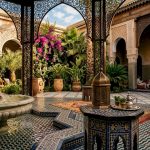
A riad can be an excellent Marrakech experience.
Traditional riads are inward-facing houses arranged around a central courtyard or garden.
Many are now operated as:
- guesthouses
- boutique accommodations
- small hotels
But “riad” does not automatically mean:
- luxurious
- quiet
- historic
- accessible
- centrally located
- better than a hotel
Evaluate the actual property.
Our Moroccan Riad Guide explains what to check before booking.
Advantages of a Medina Riad
Depending on location, a riad may give you:
- easy walking access
- historic architecture
- courtyard setting
- rooftop terrace
- small-property atmosphere
This can be especially useful for travelers who plan to spend most of their time in the historic city.
Possible Riad Disadvantages
Check carefully for:
- stairs
- lack of elevator
- vehicle access
- room size
- courtyard noise
- heating
- air conditioning
- plunge pool versus swimming pool
- distance from main streets
A beautiful photograph does not answer these questions.
A Resort Is Not Automatically an Inferior Marrakech Experience
Staying comfortably outside the medina does not prevent travelers from experiencing historic Marrakech properly.
A resort or modern hotel may be the right choice for someone who prioritizes:
- pool
- large room
- elevator
- vehicle access
- spa
- family facilities
- quiet environment
You can stay outside the medina and still explore historic Marrakech properly.
Do You Need to Split Your Stay Between Riad and Resort?
No.
Some travelers enjoy splitting their stay between a riad and a resort, but it is not a universal rule.
A split stay makes sense when:
- you have enough nights
- you genuinely want two accommodation experiences
- resort relaxation is important
It makes less sense when:
- you only have three nights
- you dislike packing
- you already have relaxation elsewhere
- the hotel change consumes valuable time
Sometimes keeping one good hotel is the more comfortable choice.
Choose Accommodation According to the Trip
A simple decision framework:
Choose a Medina Riad if you prioritize:
- historic atmosphere
- walking
- souks
- evening Medina access
Choose a Modern City Hotel if you prioritize:
- easy transportation
- larger conventional rooms
- modern facilities
Choose a Resort if you prioritize:
- pool
- spa
- gardens
- substantial relaxation
There is no need to rank them by “authenticity.”
For broader advice, see our Hotels in Morocco Guide.
Do You Need a Guide in Marrakech?
No.
Marrakech can be explored independently.
However, a professional local guide can add considerable value when:
- this is your first day in the medina
- historical context matters
- you want to understand architecture
- you have limited sightseeing time
- you want a carefully organized walking route
The guide should provide more than directions.
They should explain:
- history
- dynasties
- architecture
- religious context
- crafts
- neighborhoods
For more detail, read our Morocco Private Guides Guide.
Use a Guide for Interpretation, Not Shopping
This is particularly important in Marrakech.
Tell your guide before beginning whether you want:
- no shopping
- some shopping
- specific crafts
If you say:
“We want history and architecture and do not want shopping stops,”
the tour should respect that.
If you say:
“We are interested in carpets and ceramics,”
the route can include them.
A private city tour should not automatically become a sequence of commercial presentations.
Marrakech Medina
The medina is not one attraction.
It contains:
- residences
- markets
- religious buildings
- palaces
- museums
- restaurants
- workshops
- schools
- public spaces
and should be understood as a living urban district.
Some streets are crowded.
Others are quiet.
Some are primarily commercial.
Others are residential.
There is no need to search for “secret Marrakech.”
Walk thoughtfully through the city that actually exists.
Jemaa el-Fna
Jemaa el-Fna is one of Marrakech’s defining public spaces.
It changes throughout the day.
Depending on the time, you may encounter combinations of:
- food stalls
- juice sellers
- musicians
- performers
- storytellers
- visitors
- residents
- vendors
UNESCO has also recognized the cultural space associated with Jemaa el-Fna for its concentration of oral and performance traditions.
That makes the square more significant than simply being a night market.
Should You Visit Jemaa el-Fna During the Day or Evening?
Both can be interesting.
During daylight, the square is easier to understand spatially.
Toward evening, food stalls and entertainment can increase.
There is no need to choose one universally correct time.
If you stay nearby, pass through at different times.
Rooftop Views Over Jemaa el-Fna
A café terrace can provide useful perspective over the square.
But do not make a specific rooftop or sunset reservation mandatory.
Depending on:
- season
- weather
- table
- crowds
the experience varies.
Choose somewhere that suits the day.
Be Clear About Photos and Performances
Around Jemaa el-Fna, some performers may expect payment when visitors actively photograph or engage with them.
If you do not want an interaction:
- decline
- continue walking
If you intentionally take close photographs or participate in a performance, clarify expectations when appropriate.
Animal Experiences Around the Square
Visitors may encounter animals used for tourism or photography.
You are under no obligation to participate.
If animal welfare matters to you, simply avoid experiences you are uncomfortable supporting.
Koutoubia Mosque
The Koutoubia Mosque and its minaret are among Marrakech’s most recognizable landmarks and form a major part of the UNESCO-listed urban landscape.
The mosque dates to the Almohad period and remains an active place of worship.
For most non-Muslim visitors, the experience is primarily:
- exterior architecture
- minaret
- surrounding gardens
- urban context
General tourist access to the mosque interior should not be assumed.
Do Not Schedule the Koutoubia as a One-Hour “Attraction”
It naturally fits around:
- Jemaa el-Fna
- medina walking
- surrounding gardens
The exterior may require only a short stop.
Architecture enthusiasts may want considerably longer.
There is no mandatory duration.
Bahia Palace
Bahia Palace is one of Marrakech’s major architectural sites and is specifically promoted by Morocco’s National Tourism Office for its decorative arts, zellige, marble and gardens.
For first-time cultural sightseeing, it is often worth prioritizing.
A guide can help explain:
- late-19th-century context
- courtyards
- decorative work
- layout
- palace function
rather than simply moving from room to room for photographs.
Do You Have to Visit Bahia Palace Immediately at Opening?
No.
Visiting major monuments within the first 30 minutes after opening can sometimes mean a quieter experience.
That does not make early opening the universally correct time.
Decide based on:
- opening hours
- hotel location
- guide route
- weather
- current visitor volume
Avoid turning the sightseeing day into a competition to beat every other visitor.
Saadian Tombs
The Saadian Tombs provide important context for the Saadian dynasty and are among the major later historic monuments recognized within Marrakech’s World Heritage context.
They combine naturally with the Kasbah area and other southern-medina sites.
Whether they deserve:
- 30 minutes
- one hour
- longer
depends on interest and current waiting conditions.
El Badi Palace
El Badi Palace provides a very different experience from Bahia Palace.
Where Bahia emphasizes surviving decorative interiors, El Badi is more about:
- scale
- ruins
- palace layout
- Saadian history
If your time is limited, you do not necessarily need both.
Choose Bahia when you prioritize:
- decorative interiors
- courtyards
- zellige
- painted and carved details
Choose El Badi when you prioritize:
- historical scale
- ruins
- palace planning
- Saadian context
Architecture enthusiasts may want both.
Ben Youssef Madrasa
Ben Youssef Madrasa is one of the historic architectural highlights of Marrakech.
It is especially worthwhile for travelers interested in:
- Islamic architecture
- educational institutions
- zellige
- carved cedar
- stucco decoration
As with the palaces, current opening conditions should be checked before planning a rigid timetable.
Do Not Visit Every Monument Just Because It Appears on a List
A first-time visitor could easily schedule:
- Bahia
- Badi
- Saadian Tombs
- Ben Youssef
- Dar Si Said
- another museum
- souks
- Jemaa el-Fna
into one exhausting day.
Instead, choose the sites that fit your interests.
For example:
Architecture-focused day
- Bahia
- Ben Youssef
- selected medina architecture
History-focused day
- Saadian Tombs
- El Badi
- Kasbah
- medina
Lighter first visit
- Bahia
- souks
- Jemaa el-Fna
More attractions do not automatically create a better day.
The Souks
Marrakech’s souks remain an important part of the medina.
Visitors may encounter areas associated with:
- textiles
- leather
- metalwork
- wood
- spices
- lamps
- clothing
- carpets
- household goods
The souks are more than one enormous souvenir market.
They serve different commercial functions.
Do You Need to Visit the Souks at Dawn?
No.
Early morning can certainly be pleasant, but it is not the only worthwhile or “authentic” time to explore the souks.
Many businesses may only be beginning their day.
For most visitors, normal daytime hours work perfectly well.
Start earlier when:
- summer heat makes it useful
- photography is a priority
- your itinerary requires it
not because dawn is supposedly more authentic.
Shopping in Marrakech
Shopping can be enjoyable.
It can also consume half the sightseeing day without travelers realizing it.
Tell your guide how much shopping time you actually want.
Bargaining
There is no universal rule such as:
offer 50% of the first price.
Some sellers negotiate extensively.
Some use relatively fixed pricing.
Some products require specialist knowledge.
The useful approach is:
- understand what you are buying
- ask questions
- negotiate politely where appropriate
- buy only when comfortable
Avoid Fake “Cooperative” Guarantees
A shop being described as:
- cooperative
- government cooperative
- artisan cooperative
does not automatically guarantee:
- price
- quality
- artisan ownership
- ethical sourcing
If provenance matters, ask specific questions.
Marrakech Tanneries
Marrakech has traditional leather-working areas, but they should not automatically be included in every first-time tour.
The tannery experience in Marrakech is different from the better-known Chouara tannery in Fes.
If you have already visited Fes, another tannery stop may provide limited additional value.
More importantly, avoid accepting unsolicited street help from someone offering to “show you the tannery.”
If you want to visit, arrange it clearly through:
- guide
- accommodation
- known operator
Majorelle Garden
Jardin Majorelle is one of Marrakech’s best-known modern attractions.
The garden’s official website currently requires tickets to be purchased online through its authorized ticketing system and recommends advance reservation when visitors need a particular date and time.
This is one attraction where advance planning can genuinely be useful.
Majorelle Is Outside the Main Medina Sightseeing Cluster
This is important for itinerary design.
Do not treat:
Bahia → Ben Youssef → Majorelle → Saadian Tombs
as a simple walking route.
Majorelle is in the modern city.
It usually makes more sense to combine it with:
- Yves Saint Laurent Museum
- other modern-city activities
or visit it as a separate part of the day.
Should You Visit Majorelle Garden?
Yes if you are interested in:
- gardens
- design
- photography
- Jacques Majorelle
- Yves Saint Laurent connection
Skip it if:
- your time is very limited
- historic architecture is much more important
- gardens are not a priority
Popular does not mean mandatory.
Menara Gardens
Menara provides a different garden experience from Majorelle.
It is more open and historically connected to Marrakech’s wider landscape.
Do not treat the two gardens as interchangeable.
If you only have time for one, choose according to interest.
The Mellah
Marrakech’s historic Jewish quarter is an important part of the city’s social history.
Do not reduce the Mellah to:
- spice shops
- balconies
- photographs
Travelers interested in Jewish heritage should consider a guide who understands:
- community history
- neighborhood development
- synagogues where access is permitted
- cemetery and religious heritage
- wider Jewish history in Morocco
Our Morocco Jewish Tour develops this subject across several cities.
Private Religious Access Is Not Guaranteed
Synagogues, mosques and other religious spaces may have:
- worship schedules
- access restrictions
- security arrangements
Only rely on access arrangements that are actually confirmed.
A private guide does not automatically provide “exclusive access.”
Food in Marrakech
Marrakech is an excellent city for exploring Moroccan cuisine.
Travelers can find:
- traditional restaurants
- riad dinners
- street food
- contemporary Moroccan dining
- cafés
- bakeries
- cooking classes
The city is also strongly associated with tanjia, a slow-cooked meat dish traditionally linked with Marrakech.
Not every meal needs to be “local and hidden.”
A professional restaurant can provide an excellent Moroccan meal.
Jemaa el-Fna Food Stalls
Eating at the square can be enjoyable when you want:
- informal atmosphere
- grilled food
- soups
- snacks
- busy evening environment
Do not automatically assume:
busy stall = guaranteed food safety.
Use normal judgment.
Agree on what you are ordering and understand prices when necessary.
Restaurant Versus Street Food
There is no need to choose one.
A balanced Marrakech stay can include:
- one traditional restaurant
- one informal meal
- one contemporary restaurant
- perhaps a cooking class
according to interests.
Use our Food in Morocco Guide for broader culinary planning.
Cooking Classes
A cooking class can fit well into a three- or four-night Marrakech stay.
It is particularly useful when you genuinely enjoy:
- markets
- ingredients
- cooking
- food culture
Do not add one simply because every luxury itinerary contains a cooking class.
Ask what is included:
- market visit?
- hands-on preparation?
- demonstration only?
- meal?
- dietary accommodation?
For a food-focused journey, see our Morocco Food Tour.
Private Family Meals
Private meals inside local family homes should only be treated as an option when a genuine hosted experience has been arranged.
Only choose a home-hosted meal when:
- the host genuinely provides the experience
- the visit is arranged professionally
- consent is clear
Do not use ordinary Moroccan households as an authenticity product.
Hammam in Marrakech
Marrakech offers a very wide range of hammam experiences.
These may include:
- neighborhood/public hammams
- private hammams
- riad spas
- luxury hotel spas
There is no universally “most authentic” option.
Choose based on comfort and expectations.
Our Moroccan Hammam Guide explains what typically happens and how the options differ.
Hammam or Massage?
They are different experiences.
A hammam usually centers around:
- heat/steam
- black soap
- exfoliation
- rinsing
depending on the establishment.
Massage may be:
- separate
- optional
- part of a package
Check exactly what you are booking.
Marrakech With Children
Marrakech can work very well for families when the schedule is controlled.
Children may enjoy:
- gardens
- palace courtyards
- food
- selected crafts
- pool time
- shorter souk visits
The common mistake is giving them the same eight-hour monument-and-shopping program designed for adults.
A good family day could be:
Bahia Palace → lunch → pool/rest → Jemaa el-Fna early evening.
For broader family planning, read our Morocco With Kids Guide.
Marrakech for Senior Travelers
Marrakech can also be adapted well for senior travelers.
The main considerations are:
- walking distance
- uneven medina paving
- heat
- stairs in accommodation
- distance from vehicle to riad
- standing at monuments
A guide and driver should coordinate:
- drop-off
- pickup
- route
- rest breaks
rather than expecting travelers to complete one fixed medina circuit.
Read our Morocco for Seniors Guide.
Reduced Mobility
The question should not be:
“Is Marrakech accessible?”
Ask:
- Can a vehicle reach the hotel?
- Are there steps?
- Is there an elevator?
- What is the surface at the monument?
- How far is the walk?
- Is seating available?
- Can the walking route be shortened?
Historic Marrakech contains very different environments.
Marrakech for Solo Travelers
Marrakech can be explored independently.
Normal practical precautions include:
- keeping valuables secure
- using legitimate transport
- understanding your riad location
- avoiding unwanted guiding
- agreeing clearly before accepting services
Do not rely on blanket lists of streets that are supposedly always safe or unsafe.
For broader safety guidance, see Is Morocco Safe for Tourists? and Is Morocco Safe for Solo Women?.
Unsolicited Directions in the Medina
Visitors occasionally encounter people offering:
- directions
- guides
- tannery help
- “this road is closed” advice
If you need help:
- ask your accommodation
- ask your licensed guide
- ask an established business
- use navigation as support
You do not need to accept unsolicited assistance.
Marrakech for Photographers
The city provides strong photographic subjects:
- architecture
- souks
- doors
- crafts
- courtyards
- markets
- gardens
- Jemaa el-Fna
But there is no single correct photography schedule.
Light varies by:
- season
- weather
- street orientation
and the medina is a working residential environment.
Ask before photographing people closely.
For a dedicated route, see our Morocco Photography Tour.
Marrakech Weather
Marrakech has substantial seasonal variation.
Summer can be very hot.
Winter days can be pleasant while mornings and evenings may be considerably cooler.
Spring and autumn work well for many visitors.
But do not rely only on fixed monthly temperature tables.
Check the forecast close to travel.
Use our Morocco Weather Guide for regional seasonal advice.
Summer in Marrakech
During periods of significant heat:
- begin outdoor sightseeing earlier when useful
- reduce prolonged exposure
- take proper breaks
- use shaded or indoor activities
- drink appropriately
- avoid forcing a winter-style itinerary into summer
But there is no rigid rule that no outdoor activity should occur between exactly noon and 3 PM from May through September.
Weather varies by day and month.
Use current conditions.
Winter in Marrakech
Winter can be excellent for cultural touring.
Travelers should still bring layers.
Also check accommodation heating.
Traditional properties that look warm in photographs can sometimes feel cool at night.
What to Wear in Marrakech
Choose clothing according to:
- weather
- walking
- hotel
- restaurant
- cultural context
There is no citywide rule requiring shoulders and knees to be covered at all times.
Religious environments may deserve more conservative clothing.
For the complete trip, read What to Wear in Morocco.
Marrakech and the High Atlas
Marrakech is one of the principal gateways to the High Atlas.
But “Atlas Mountains day trip” can mean very different things.
Possible experiences include:
- Imlil
- Ourika Valley
- Ouirgane
- hiking
- village stay
- longer trek
Choose according to:
- walking ability
- season
- weather
- purpose
Read our Atlas Mountains Morocco Guide before choosing the excursion.
Imlil
Imlil is particularly useful when:
- hiking interests you
- mountain scenery matters
- you want to understand the Toubkal region
You do not have to climb Mount Toubkal to make Imlil worthwhile.
Shorter walks and village-based experiences are possible.
Ourika Valley
Ourika is another common Marrakech excursion.
It can work for travelers wanting:
- mountain scenery
- valley environment
- a relatively accessible day outside Marrakech
Do not assume waterfall walking is suitable for everyone.
Some paths can involve:
- uneven ground
- rocks
- climbing
Assess current conditions and individual ability.
Agafay
Agafay lies much closer to Marrakech and can provide a convenient arid-landscape excursion.
But it is essential to understand it correctly.
Agafay is not the Sahara.
It does not offer Erg Chebbi-style large sand dunes.
Its strengths are:
- proximity to Marrakech
- rocky landscape
- camps
- meals
- activities
- short overnight escape
Read our Agafay Desert Morocco Guide before deciding whether it suits your trip.
Agafay or Merzouga?
This is not a quality comparison.
They solve different itinerary problems.
Choose Agafay when:
- you have limited time
- you want an easy Marrakech escape
- you want dinner or one overnight in an arid landscape
Choose Merzouga when:
- the Sahara is an important trip priority
- you have enough days for the road journey
- Erg Chebbi dunes matter to you
- you want the wider southeastern route
Agafay should not be mistaken for “the Marrakech Sahara.”
Marrakech to Merzouga
Merzouga is not a simple desert excursion from Marrakech.
The journey typically forms part of a multi-day route through southern Morocco.
A logical sequence can include:
Marrakech → High Atlas → Ait Ben Haddou → Dades/Todra → Merzouga
followed by either:
Merzouga → Fes
or a carefully planned return route.
Read our Merzouga Morocco Guide for the destination itself.
Avoid the Direct Marrakech–Merzouga–Marrakech Rush
If Fes is already in the trip, consider continuing from Merzouga toward Fes.
For example:
Marrakech → Dades → Merzouga → Fes
often makes more geographical sense than returning all the way to Marrakech and later traveling north again.
The complete route should decide.
Marrakech and Essaouira
Essaouira is another popular connection.
You can:
- make a day trip
- stay one night
- stay two or more
according to how important the Atlantic coast is.
A day trip is not automatically wrong.
An overnight is particularly useful when you want:
- evening
- seafood
- photography
- relaxed beach time
Read our Essaouira Morocco Guide before choosing.
Marrakech → Essaouira → Agadir
When the trip continues south along the Atlantic coast, consider moving forward:
Marrakech → Essaouira → Agadir
rather than returning unnecessarily to Marrakech.
Our Agadir Morocco Guide explains how Essaouira and Agadir serve different coastal travel styles.
Marrakech as the Final City
Marrakech is often an excellent place to finish a Morocco journey.
For example:
Fes → Merzouga → Dades → Marrakech
creates a natural cross-country progression.
Ending here may also be convenient when your flight departs from Marrakech Menara Airport.
After several road days, a final stay can include:
- sightseeing
- hammam
- shopping
- food
- free day
without another major transfer.
Do You Need a Full Recovery Day After the Sahara?
No universal rule.
Some travelers will appreciate a complete recovery day after a Sahara circuit.
Others arrive in Marrakech comfortably and prefer light sightseeing.
A better approach is to avoid scheduling an intensive guided program immediately after a very long travel day.
That might mean:
- free evening
- late start
- hammam
- light garden visit
rather than automatically sacrificing an entire day.
Marrakech as the First City
Marrakech can also work perfectly as the first destination.
This is especially logical when your journey focuses on:
- High Atlas
- southern Morocco
- Sahara
- Essaouira
A possible progression is:
Marrakech → High Atlas → Ait Ben Haddou → Dades → Merzouga
rather than flying into Casablanca simply because it is the country’s largest international gateway.
Train Travel From Marrakech
Marrakech is connected to Morocco’s rail network.
Train can be useful for journeys involving cities such as:
- Casablanca
- Rabat
- other rail-connected destinations
For current schedules, use ONCF rather than relying on fixed departure times.
Read our Morocco Train Guide for when rail makes sense.
Train or Private Driver?
Use the transport that suits the route.
Train works well for:
- direct city-to-city journeys
- independent travelers
- routes without sightseeing stops
Private vehicle works well for:
- High Atlas
- southern road routes
- Sahara circuits
- door-to-door luggage logistics
- customized stops
Private transfers are not automatically superior for every route.
Hot-Air Balloon Flights
Hot-air ballooning is available in the wider Marrakech area.
If interested, treat it as a weather-dependent activity.
Confirm:
- operator
- pickup
- flight conditions
- cancellation policy
- exact inclusions
Do not make it a mandatory “luxury Marrakech” experience.
Weather always controls whether a balloon flight operates.
Golf
Marrakech also has a substantial golf offering and can work well for travelers combining:
- golf
- medina
- resort
- cultural sightseeing
This usually changes the accommodation strategy because staying close to the preferred courses may be more useful than a deep-medina riad.
See our Morocco Golf Tour if golf is one of the primary reasons for the trip.
Example: Two Nights in Marrakech
Day 1
Arrive Marrakech.
Keep the day light according to arrival time.
Possible evening:
- Jemaa el-Fna
- dinner
Day 2
Main cultural sightseeing day.
Choose a realistic combination such as:
- Bahia Palace
- selected historic site
- medina/souks
- Jemaa el-Fna
Day 3
Continue toward:
- Essaouira
- Atlas
- southern Morocco
- airport
This works well when Marrakech is one section of a larger circuit.
Example: Three Nights in Marrakech
Day 1
Arrival and light medina exploration.
Day 2
Guided cultural day.
For example:
- Bahia Palace
- Saadian or Badi
- medina
- souks
- Jemaa el-Fna
Day 3
Choose one theme:
Gardens: Majorelle + related museum.
Food: market/cooking experience.
Relaxation: hammam + free time.
Independent: souks + cafés + shopping.
Day 4
Continue.
This gives Marrakech a proper visit without trying to see everything.
Example: Four Nights in Marrakech
Day 1
Arrival.
Day 2
Historic Marrakech.
Day 3
Modern/garden/food day.
Day 4
Choose:
- free day
- Atlas excursion
- Agafay
- additional Marrakech experiences
Day 5
Continue.
The fourth night has a purpose rather than simply extending the stay.
Example: Marrakech at the End of a Sahara Journey
Day 1
Arrive from Dades/Ouarzazate direction.
Check in.
Keep the evening easy.
Day 2
Guided Marrakech day.
Day 3
Gardens, food, hammam or free time.
Day 4
Departure.
This can provide a much more comfortable ending than attempting sightseeing immediately after a long road journey.
Common Marrakech Planning Mistakes
Treating Marrakech only as “the Red City”
Fine as a nickname, but it does not explain the city by itself.
Treating Marrakech as constant “sensory overload”
The city is more useful when understood through practical experiences, neighborhoods and cultural sites.
Assuming dawn is the only authentic time to see the medina
It is not.
Equating a medina riad with authentic travel
Accommodation preferences vary.
Assuming resorts isolate travelers from the real Marrakech
They do not have to.
Splitting every stay between a riad and resort
Moving hotels is not always worthwhile.
Assuming private transport is the only correct option
Taxi, bus, train and walking all have roles.
Assuming VIP or exclusive labels always mean a better experience
Focus on what is actually included.
Expecting exclusive cultural access
Only rely on genuine confirmed arrangements.
Scheduling every palace in the first 30 minutes after opening
Build a sensible route instead.
Avoiding all outdoor sightseeing from exactly noon to 3 PM for five months
Use the actual forecast.
Assuming everyone needs a full recovery day after every Sahara trip
Adapt to the traveler.
Mistaking Agafay for the Sahara
It is not.
Treating Merzouga as a Marrakech day excursion
It requires a multi-day route.
Assuming October through March is universally the optimal Sahara season
Different seasons require different planning.
Expecting quiet souks at dawn
Street activity varies.
Treating private family homes as tourism props
Only arrange legitimate hosted experiences.
Assuming a cooking class makes every itinerary better
Add it for people who genuinely enjoy cooking.
Treating shopping stops as cultural necessities
Shopping should be optional.
Assuming every artisan business is a cooperative
Verify what it actually is.
Assuming the deepest medina riad is automatically best
Access matters.
Ignoring luggage logistics
Confirm the final walk before arrival.
Scheduling Majorelle in the middle of a medina walking sequence
It is outside the historic sightseeing cluster.
Trying to see every palace, madrasa and museum in one day
Prioritize.
Automatically adding Atlas, Agafay and Essaouira as day trips
Each day outside Marrakech reduces actual Marrakech time.
Leaving Marrakech without considering the next route direction
Continue forward when possible.
Frequently Asked Questions
Is Marrakech worth visiting?
Yes. Marrakech combines a UNESCO-listed medina, major historic architecture, souks, Jemaa el-Fna, gardens, food and convenient access to southern Morocco.
How many days do I need in Marrakech?
Two nights can work in a faster itinerary. Three nights suit many first-time visitors. Four or more make sense when Marrakech itself, food, relaxation or nearby excursions are major priorities.
Is Marrakech Medina a UNESCO World Heritage Site?
Yes. The Medina of Marrakesh has been on UNESCO’s World Heritage List since 1985.
What should I see on my first visit?
Priorities often include Jemaa el-Fna, Koutoubia, Bahia Palace and selected medina areas. Add Saadian Tombs, El Badi, Ben Youssef or gardens according to your interests.
Do I need a guide in Marrakech?
No, but a professional local guide can add significant historical context and create a more efficient first medina visit.
Can I explore Marrakech Medina alone?
Yes. Many travelers do. Save your accommodation location and understand your vehicle meeting point before wandering far from the main streets.
Should I stay in a riad?
A riad is a good choice if you value historic architecture and medina access. Check stairs, vehicle access, room facilities and luggage arrangements before booking.
Should I stay in a resort?
A resort can be the better option when pool, spa, space and quiet are major priorities.
Should I split my stay between a riad and resort?
Only if you have enough nights and genuinely want both experiences. It is not necessary for most short stays.
Is Jemaa el-Fna better at night?
Evening brings more food stalls and activity, while daytime offers a different view of the square. If possible, see it at more than one time.
Can non-Muslims enter Koutoubia Mosque?
General tourist access to active mosque interiors is restricted. Visitors can appreciate the exterior and surrounding area.
Is Majorelle Garden worth visiting?
Yes for travelers interested in gardens, design and the Yves Saint Laurent connection. Current tickets should be booked through the official Jardin Majorelle ticketing system.
Is Agafay the Sahara Desert?
No. Agafay is a rocky arid landscape near Marrakech. Merzouga and Erg Chebbi provide the major Sahara dune experience.
Can I visit Merzouga from Marrakech in one day?
It should not be planned as an ordinary day trip. A proper Marrakech–Merzouga journey is a multi-day road route through southern Morocco.
Can I visit the Atlas Mountains from Marrakech?
Yes. Several mountain areas can be reached from Marrakech, but the appropriate destination depends on whether you want scenery, villages, hiking or an overnight mountain stay.
Can I visit Essaouira from Marrakech?
Yes. It can be visited as a day trip or overnight. Stay longer when the Atlantic coast is an important part of your journey.
Is Marrakech good for families?
Yes. Keep the sightseeing day realistic and combine cultural visits with gardens, pool or free time.
Is Marrakech suitable for senior travelers?
Yes. Accommodation access, walking distance, heat and vehicle pickup should be planned according to individual mobility.
Is Marrakech good as the first city in Morocco?
Yes, particularly for trips centered on southern Morocco, the Atlas, Sahara or Essaouira.
Is Marrakech good as the final city?
Yes. It works particularly well at the end of routes arriving from Merzouga, Dades and the High Atlas and can be convenient for flights from Marrakech Menara Airport.
Plan Marrakech as a City, Not a Collection of “Exclusive Experiences”
Marrakech does not need exaggerated promises about:
- VIP access
- secret rooftops
- private cultural doors
- the “real Marrakech”
- luxury immersion
- perfect dawn moments
Its strengths are already enough.
A successful first visit usually comes from:
- choosing a realistic number of nights
- deciding whether a medina riad or modern hotel suits your group
- arranging clear luggage and vehicle access
- using a knowledgeable guide when interpretation matters
- prioritizing a few monuments rather than every attraction
- making shopping optional
- leaving enough unstructured time
- understanding the difference between Agafay and the Sahara
- connecting Marrakech efficiently with the next destination
For travelers heading toward the mountains, continue with our Atlas Mountains Guide.
For a nearby arid-landscape escape, read our Agafay Desert Guide.
For a full Sahara journey, use our Morocco Desert Guide and Merzouga Guide.
If your route continues west, see our Essaouira Guide.
For complete private itineraries, compare our Morocco Tour Packages or contact MoroccoTours.co with your dates, arrival city, departure city and preferred travel pace.